Cymraeg CY

Welcome to the Celftastig Website


This is a website for practitioners and 11-14 year old learners, with the aim of providing tools and ideas based on activities to inspire the learners to develop the skills of exploring, creating and responding to art. The website is designed around 4 central themes, with an opportunity to look in more detail at the work of around 4 artists under each theme. The activities cover several themes and correspond to various areas of learning and experience in the Curriculum for Wales. These activities are tailored for progression steps 3 and 4 but can be adjusted according to the learner's ability and requirements. You do not need to complete all the activities or follow the order in which they are presented within the themes.

Themes and Artists

Environment

Mary Lloyd Jones, Manon Awst, Tim Pugh a Tim Davies

Identity

Catrin Williams, Lowri Davies a Tomos Sparnon

Culture

Ann Catrin Evans, Mari Thomas, Meinir Mathias a Ruth Jên

Politics

Ifor Davies, Iwan Bala, Neale Howells a Peter Finnemore

There are three sections for each artist.

In the 'Exploring' section, you will find information about the artists in the form of text, pictures, and sound - what inspires them, how exploring through experimentation creates different types of work, along with examples of their work, and the mood and ideas that are conveyed in them.

In the 'Response' section, you will find examples of resources and activities that can be used to develop the learners’ personal response skills to works of art. There is a particular focus on stimulating literacy skills by evaluating and explaining the impact of mood, emotion, and ideas.

In the 'Creating' section, you will find examples of plans and resources that could be used for projects, which experiment with different techniques to emulate the artists' styles. You can either download and print these resources or use them interactively on a device through the Hwb's pdf reader.

Explore and enjoy!
Ann Catrin Evans

Pwy wyt ti?

Ann Catrin Evans ydw i.

Ble cest ti dy eni?

Ces i fy ngeni ym Mangor, Gogledd Cymru.

Ble cest ti dy addysg?

Es i Brifysgol Bangor rhwng 1987-88 i astudio cwrs sylfaen (foundation) mewn celf (art). Es i ymlaen i Brifysgol Brighton a gwnes i gwrs gradd BA Dylunio (Design) 3D mewn pren (wood), metel, serameg a phlastig.

Pa ddefnyddiau (materials) wyt ti’n hoffi defnyddio?

Dw i’n hoffi defnyddio dur (steel) i wneud addurniadau (decorations) i’r cartref. Dw i hefyd yn defnyddio efydd di-staen (stainless bronze), alwminiwm, arian, copr ac aur (gold) i wneud fy ngemwaith (gemwaith - jewellery).

Beth ydy dy ‘broses’ di?

Dw i’n dylunio (design) syniadau (ideas) yn gyntaf.

Dw i'n gwneud popeth â llaw (by hand).

What is your background?

I was born in Bangor in 1967 and after studying an Art Foundation course at Bangor University between 1987 and 1988, I went on to Brighton University. There, I followed a BA 3D Design degree in wood, metal, ceramics and plastic. I graduated in 1989.

I am an internationally known sculptor and jeweller who has exhibited my work in Wales, Britain, America and Japan. I have also been at the forefront of Welsh craft for over 25 years and won the Gold Medal at the National Eisteddfod in 1993.

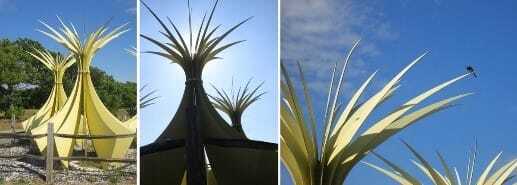
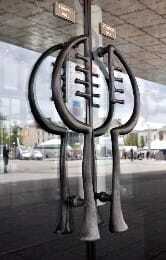
I have created large-scale public art, and architectural sculptures that appear on the doors of the Wales Millennium Centre building in Cardiff Bay. As well as creating large-scale pieces, I also enjoy making small, detailed pieces of jewellery in contrasting metallic design.

What or who has influenced/inspired you the most? 

It can be said that the Welsh heritage and culture has influenced my work, combining the beauty of the craft and the practicality of the piece. I want to create pieces that are both beautiful and useful.

I like simplicity in design. I try to show the character of raw material in the design by expanding natural organic features and incorporating fine details in a piece of art. I love the idea of ​​having beautiful objects around us. I enjoy the process of designing with this in mind and creating an abstract form that conveys a story or a narrative or a feeling.

Explain the process that you follow when creating a piece of art.

I mainly design ideas first, before using traditional approaches, casting and general fabrication, as well as more up-to-date techniques using laser cutting technology and rapid prototyping. Each piece is handmade. Working with precious metals, as well as iron and basic metals, develops new technology skills and techniques used in blacksmithing, which means I continuously develop as an artist.

Which media/materials do you enjoy using the most?

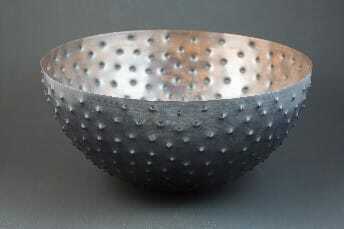
I use mainly steel to create decorative pieces for the home, but also stainless bronze, aluminium, copper silver and gold to create my jewellery. Balance, proportion and simplicity are key features of my work.

How has your work changed and developed over time? 

My work has developed and changed with the latest technology and is combined with traditional 3D creating techniques.

Complete these activies. Your work will be marked as you go. Remember to take a screenshot of your answers to keep in your personal record.

Activity 1

“I was born in Bangor in 1967, and after studying an Art Foundation course at Bangor University between 1987 and 1988, I went on to Brighton University. There, I followed a BA 3D Design degree in wood, metal, ceramics and plastic. I graduated in 1989. ”
“I am an internationally known sculptor and jeweller who has exhibited my work in Wales, Britain, America and Japan. I have also been at the forefront of Welsh craft for over 25 years and won the Gold Medal at the National Eisteddfod in 1993. ”
“I use mainly steel to create decorative pieces for the home, but also stainless bronze, aluminium, copper silver and gold to create my jewellery. Balance, proportion and simplicity are key features of my work.”
“I mainly design ideas first, before using traditional approaches, casting and general fabrication, as well as more up-to-date techniques using laser cutting technology and rapid prototyping. Each piece is handmade. Working with precious metals, as well as iron and basic metals, develops new technology skills and memory techniques, leading to continuous development.”

Activity 2

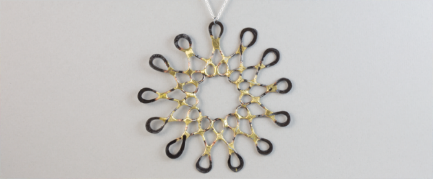
These pieces are influenced by Welsh love spoons. Firstly, look carefully at each piece. What can you see? What symbols are there?

Now read these descriptions and drag them to the correct places on the picture:

1.
2.
3.
4.
  1. Two people facing each other, embracing (hugging). A ladder to climb together.
  2. Wings carrying a ring.
  3. Three hearts. Balance. Harmony.
  4. Two hearts, like the hands of a clock, hanging from a ring.

Can you create similar descriptions for the other pieces?

Remember to take a screenshot of your answers to keep in your personal record.

Vocabulary

architectural - belonging to the art of designing and constructing buildings

heritage - features that belong to a particular country or society (e.g. traditions, languages or buildings), that were created in the past and have been passed on from one generation to the next

abstract form - a form that doesn't try to represent external reality, but conveys meaning uses shapes, colours, and textures instead

narrative - a description of events

casting - making pieces from material that is melted and then poured into a mould

fabrication - the process of making large or technically difficult artworks

prototyping - making a draft version which lets the artist explore their ideas before creating the artwork

blacksmithing - making things from iron by hand