Cymraeg CY

Welcome to the Celftastig Website


This is a website for practitioners and 11-14 year old learners, with the aim of providing tools and ideas based on activities to inspire the learners to develop the skills of exploring, creating and responding to art. The website is designed around 4 central themes, with an opportunity to look in more detail at the work of around 4 artists under each theme. The activities cover several themes and correspond to various areas of learning and experience in the Curriculum for Wales. These activities are tailored for progression steps 3 and 4 but can be adjusted according to the learner's ability and requirements. You do not need to complete all the activities or follow the order in which they are presented within the themes.

Themes and Artists

Environment

Mary Lloyd Jones, Manon Awst, Tim Pugh a Tim Davies

Identity

Catrin Williams, Lowri Davies a Tomos Sparnon

Culture

Ann Catrin Evans, Mari Thomas, Meinir Mathias a Ruth Jên

Politics

Ifor Davies, Iwan Bala, Neale Howells a Peter Finnemore

There are three sections for each artist.

In the 'Exploring' section, you will find information about the artists in the form of text, pictures, and sound - what inspires them, how exploring through experimentation creates different types of work, along with examples of their work, and the mood and ideas that are conveyed in them.

In the 'Response' section, you will find examples of resources and activities that can be used to develop the learners’ personal response skills to works of art. There is a particular focus on stimulating literacy skills by evaluating and explaining the impact of mood, emotion, and ideas.

In the 'Creating' section, you will find examples of plans and resources that could be used for projects, which experiment with different techniques to emulate the artists' styles. You can either download and print these resources or use them interactively on a device through the Hwb's pdf reader.

Explore and enjoy!
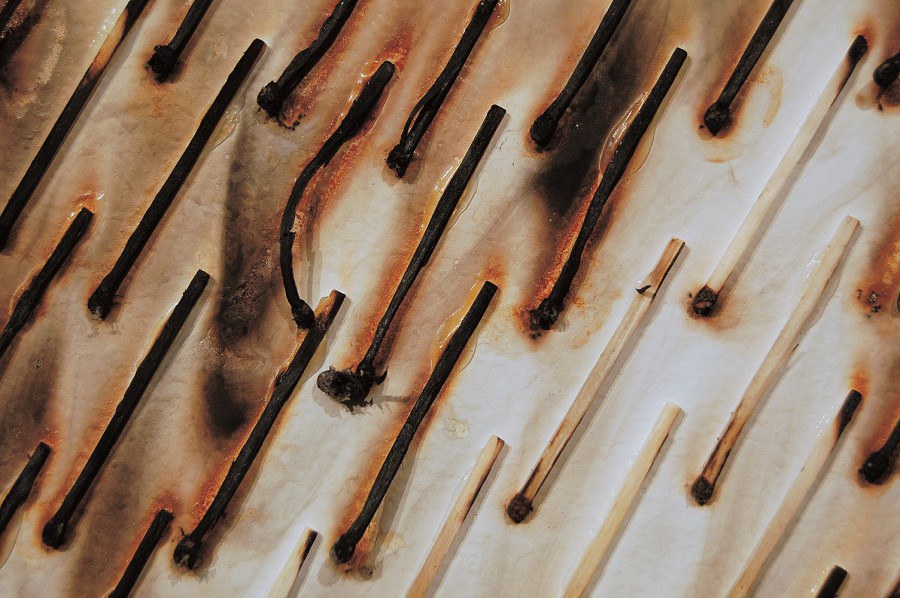
Tim Davies

Pwy wyt ti?

Tim Davies ydw i.

Ble cest ti dy fagu?

Ces i fy magu yn Sir Benfro.

Disgrifia dy addysg?

Es i i ysgolion Celf yn Llundain, Norwich a Chaergaint (Caergaint - Canterbury)

Pa fath o artist wyt ti?

Artist gweledol (visual) ydw i.

Pa ddefnyddiau rwyt ti’n hoffi eu defnyddio?

Dw i’n hapus i ddefnyddio unrhyw beth i ddweud y gwir (to tell the truth).

Beth ydy dy ‘broses’ di?

Dw i’n dechrau gydag ymateb (response) i rywbeth.

Mae llawer o arbrofi (experimenting) a methu (failure) cyn cyrraedd y gwaith terfynol (final).

What is your background?

I’m from Pembrokeshire originally and went to art schools in London, Norwich and Canterbury. My mum worked as a cook in a nursing home and my dad was a car mechanic.

What or who has influenced you the most?

When I was at school, I enjoyed cycling from my home in Johnston to the Graham Sutherland Gallery in Picton. Sutherland’s landscapes were an early inspiration. Some of the work from this gallery has now been transferred to Oriel y Parc in St. David’s.

At Norwich School of Art, Ana Maria Pacheco was in charge of Fine Art. As well as being an inspirational painter, printmaker and sculptor, she instilled a sense of discipline and brought out the best in all her students by encouraging them to work hard and follow their own vision.

My Master’s degree at Canterbury was in Art and Architecture. This helped me to focus on the idea of site-responsive and site-specific art practice.

Other major influences include artists of the Italian Renaissance, especially Giotto, Piero della Francesca, Bellini, Caravaggio and Tintoretto; 19th century artists such as Cezanne and Van Gogh; 20th century artists including Picasso, Rothko, Rauschenberg, Abromovic and Mendieta; and more recent artists like Salcedo, Whiteread, Gates and Bruguera.

Music is a huge inspiration to me. Max Richter, Steve Reich, Philip Glass, Benjamin Britten and Thomas Tallis are some of my favourite composers. I also love the work of David Bowie, PJ Harvey, The Dead Weather, Radiohead and Nick Cave.

Explain the process that you follow when creating a piece of art.

I always start with a response to something, whether this is political, cultural, temporal or situational. Initially I make written notes and then think about how my ideas can be made into material or performative form. There are a lot of trials and errors, with many failures on the way, before getting to a final version which I’m reasonably happy with. This is not to say that the resultant work is a definitive statement, it’s just a point at which I want to pin it down. I often make several versions or a series of related pieces.

If I use materials, I try to choose whatever is most appropriate for the idea and reach for as simple and clear an outcome as possible. Part of this process is experimenting and playing with different materials. If it’s a performative work, again constant trial and revision is key. Performative pieces are usually recorded via photos or video.

Which media/materials do you enjoy using the most?

I don’t have a favourite since as long as it offers something to the concept, anything really is up for grabs.

How has your work changed and developed over time?

When I was a student, I initially used mostly painting and printmaking, though in the final year of my degree course and in my MA course I started to incorporate found materials such as textiles, building materials and reclaimed wood.

After I finished studying, I continued with this mixed media approach and eventually developed work utilising photography and video. Informing all of this was an intense growing awareness of site and text as being the impulse for much of my work.

Complete these activies. Your work will be marked as you go. Remember to take a screenshot of your answers to keep in your personal record.

Activity 1

frenetic
site-specific
site-responsive
counterpoint
two dimensional
audio overflow
When contrast is used to emphasize or complement another aspect of the artwork.
When the artist responds to the site of the artwork while creating it.
When the composition has dimensions of length and width but no dimension of depth.
When something moves quickly and vigorously in a quite wild and uncontrolled way.
When audio flows from one location to the next.
When a piece of art is created at a site and/or responds to the site.

Activity 2

Remember to take a screenshot of your answers to keep in your personal record.

Vocabulary

landscape(s) - view(s) of the countryside, or the art of making pictures of the views

sculptor - a person who creates sculptures

site responsive art - art that responds directly to the environment where the piece of art has been created

site-specific art - a piece of art that has been created for a specific location and is connected to that location