Cymraeg CY

Welcome to the Celftastig Website


This is a website for practitioners and 11-14 year old learners, with the aim of providing tools and ideas based on activities to inspire the learners to develop the skills of exploring, creating and responding to art. The website is designed around 4 central themes, with an opportunity to look in more detail at the work of around 4 artists under each theme. The activities cover several themes and correspond to various areas of learning and experience in the Curriculum for Wales. These activities are tailored for progression steps 3 and 4 but can be adjusted according to the learner's ability and requirements. You do not need to complete all the activities or follow the order in which they are presented within the themes.

Themes and Artists

Environment

Mary Lloyd Jones, Manon Awst, Tim Pugh a Tim Davies

Identity

Catrin Williams, Lowri Davies a Tomos Sparnon

Culture

Ann Catrin Evans, Mari Thomas, Meinir Mathias a Ruth Jên

Politics

Ifor Davies, Iwan Bala, Neale Howells a Peter Finnemore

There are three sections for each artist.

In the 'Exploring' section, you will find information about the artists in the form of text, pictures, and sound - what inspires them, how exploring through experimentation creates different types of work, along with examples of their work, and the mood and ideas that are conveyed in them.

In the 'Response' section, you will find examples of resources and activities that can be used to develop the learners’ personal response skills to works of art. There is a particular focus on stimulating literacy skills by evaluating and explaining the impact of mood, emotion, and ideas.

In the 'Creating' section, you will find examples of plans and resources that could be used for projects, which experiment with different techniques to emulate the artists' styles. You can either download and print these resources or use them interactively on a device through the Hwb's pdf reader.

Explore and enjoy!
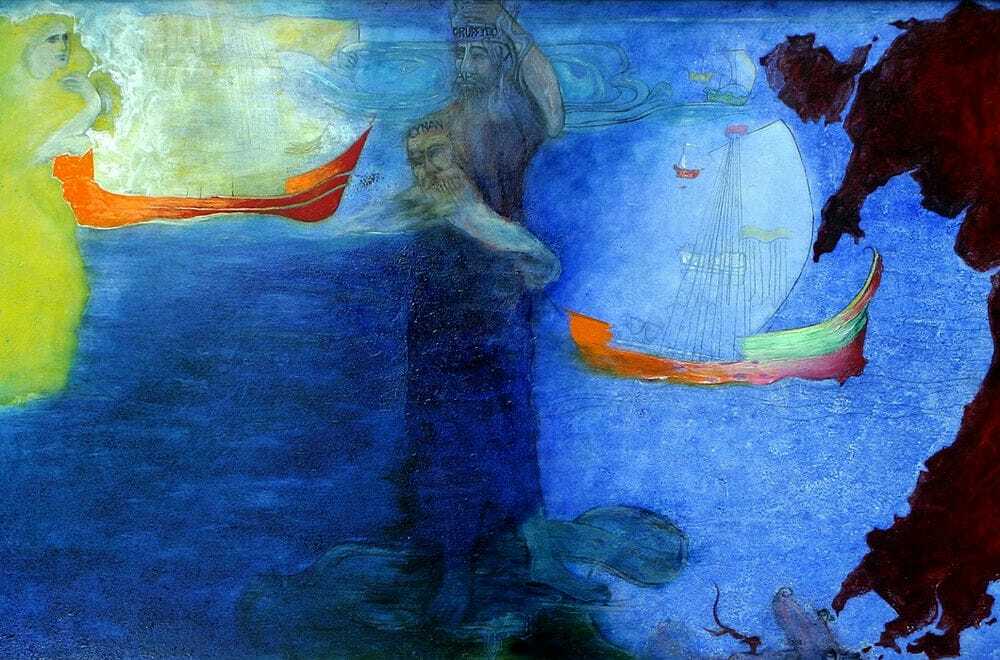
Ifor Davies

Pwy wyt ti?

Ifor Davies ydw i.

Ble cest ti dy fagu?

Ces i fy magu ym Mhenarth.

Ble est ti i’r ysgol?

Es i i Ysgol Ramadeg Penarth.

Disgrifia dy addysg.

Astudiais i (I studied) yng Ngholeg Celf Caerdydd a Choleg Celf Abertawe. Wedyn rhwng 1959 a 1961, astudiais i ym Mhrifysgol Lausanne yn y Swistir.

Pa ddefnyddiau wyt ti’n hoffi eu defnyddio?

Dw i’n hoffi defnyddio pob math (all kinds) o gyfryngau (media) a defnyddiau (materials). Dw i’n mwynhau arbrofi (experiment) gyda chyfryngau anghyfarwydd (unfamiliar).

Beth ydy dy ‘broses’ di?

Dww i’n dilyn proses wahanol bob tro. Dw i'n dechrau drwy edrych ar natur neu’r byd (world) o fy nghwmpas (around me).

What is your background?

I was born in Treharris in 1935 and raised in a bilingual home in Penarth. I studied at Cardiff College of Art and Swansea College of Art. Then from 1959 to 1961, I studied at the University of Lausanne in Switzerland. I was an art history lecturer at the University of Wales Cardiff and the University of Edinburgh before being appointed head of the department of Cultural Studies at Gwent College of Higher Education.

At the Pembrokeshire National Eisteddfod in 2002, I won a gold award for my work in Fine Art and used the prize money to create and set up my own prize - the Ifor Davies Prize. I judge the competition. In 2007 I received an MBE in the New Year's Honours list.

What or who has influenced/inspired you most?

Gwyn Daniel has had a great influence on me. We met when I was about seven years old. He introduced me to the treasures of the Welsh language and culture.

Explain the process that you follow when creating a piece of art.

If possible, I follow a different process each time. I'll start by looking at nature or the world around me. Or I will create accidental pictures, e.g. poured paint. I will also look at old unfinished photos.

Which media/materials do you enjoy using the most?

I use all kinds of media and materials to create paintings, even unfamiliar objects. (I also enjoy experimenting with unfamiliar media).

How has your work changed and developed over time?

My awareness of the Welsh language, its history, culture, special mythology and Welsh symbolism has increased, especially since joining the Rebecca Art Group. The Rebecca Art Movement is a group of artists formed in Wales around 1974. The name comes from the Rebecca Riots, 1839 - 1844.

Complete these activies. Your work will be marked as you go. Remember to take a screenshot of your answers to keep in your personal record.

Activity 1

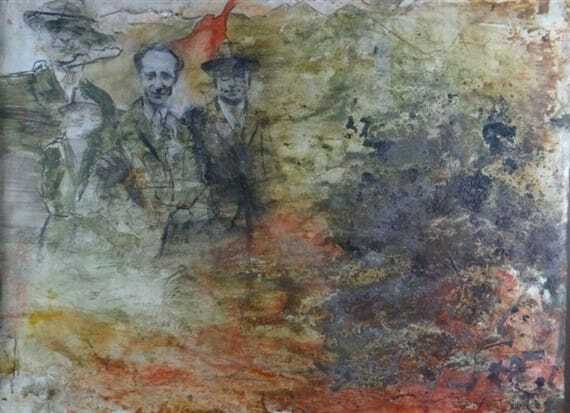
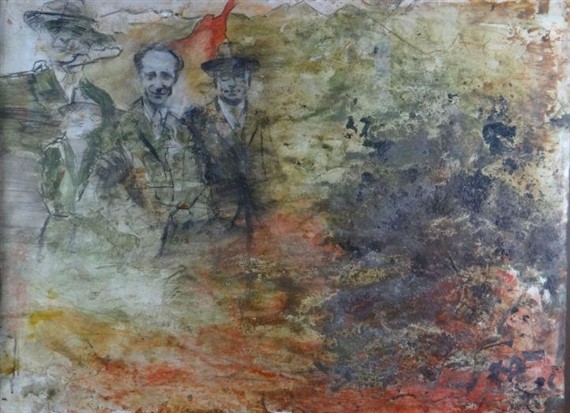
The three were arrested for burning down a bombing school in 1936 to protest against the UK government’s decision to build a place in north Wales that would promote war. Look at the picture and reflect on how it represents the lives of the three men and what they did.

Activity 2

Here is an extract from the Welsh fact file about Ifor Davies.
Dewiswch y geiriau cywir i lenwi’r bylchau / Choose the correct words to fill the gaps.

Ifor Davies ydw i.  Ces i fy magu ym Mhenarth. i i Ysgol Ramadeg Penarth. i yng Ngholeg Celf a Choleg Celf Abertawe. Wedyn rhwng 1959 a 1961, astudiais i ym Mhrifysgol Lausanne yn y . Dw i’n hoffi pob math o gyfryngau.

Remember to take a screenshot of your answers to keep in your personal record.

Vocabulary

bilingual - speaking two languages

unfamiliar - not having knowledge or experience of something

mythology - a collection of myths and legends

Rebecca Riots - These were riots that took place between 1839 and 1843 in west and mid Wales to protest against the high levels of taxes at the time. The protestors (who were men) dressed as women to disguise themselves. They were called 'Merched Beca' (Rebecca's Daughters).