Cymraeg CY

Welcome to the Celftastig Website


This is a website for practitioners and 11-14 year old learners, with the aim of providing tools and ideas based on activities to inspire the learners to develop the skills of exploring, creating and responding to art. The website is designed around 4 central themes, with an opportunity to look in more detail at the work of around 4 artists under each theme. The activities cover several themes and correspond to various areas of learning and experience in the Curriculum for Wales. These activities are tailored for progression steps 3 and 4 but can be adjusted according to the learner's ability and requirements. You do not need to complete all the activities or follow the order in which they are presented within the themes.

Themes and Artists

Environment

Mary Lloyd Jones, Manon Awst, Tim Pugh a Tim Davies

Identity

Catrin Williams, Lowri Davies a Tomos Sparnon

Culture

Ann Catrin Evans, Mari Thomas, Meinir Mathias a Ruth Jên

Politics

Ifor Davies, Iwan Bala, Neale Howells a Peter Finnemore

There are three sections for each artist.

In the 'Exploring' section, you will find information about the artists in the form of text, pictures, and sound - what inspires them, how exploring through experimentation creates different types of work, along with examples of their work, and the mood and ideas that are conveyed in them.

In the 'Response' section, you will find examples of resources and activities that can be used to develop the learners’ personal response skills to works of art. There is a particular focus on stimulating literacy skills by evaluating and explaining the impact of mood, emotion, and ideas.

In the 'Creating' section, you will find examples of plans and resources that could be used for projects, which experiment with different techniques to emulate the artists' styles. You can either download and print these resources or use them interactively on a device through the Hwb's pdf reader.

Explore and enjoy!
Meinir Mathias

Pwy wyt ti?

Meinir Mathias ydw i.

Ble cest ti dy fagu?

Ces i fy magu yng Ngheredigion.

Disgrifia dy addysg.

Ar ôl gadael yr ysgol, astudiais i (I studied) gwrs (cwrs – course) BA a MA mewn Celfyddyd Gain (Fine Art) yng Ngholeg Celf Caerfyrddin.

Pa ddefnyddiau wyt ti’n hoffi eu defnyddio?

Dw i’n hoffi defnyddio paent a phrosesau printio intaglio yn bennaf (mostly).

Beth ydy dy ‘broses’ di?

Dw i bob amser (always) yn cario llyfr braslunio (sketchbook) bach. Dw i'n cael llawer o syniadau (ideas) trwy sgwrsio (chatting), trwy’r bobl rydw i'n cyfarfod, straeon a hanes. Yn aml (often), mae'r syniadau'n dod trwy brofiad personol (personal experience) ac o fy magwraeth (upbringing) neu'r amgylchedd (environment).

What is your background?

I’m a contemporary Welsh artist currently living in Ceredigion, west Wales. Through my work, I explore ideas relating to cultural memory, history, land and people. I work from my studio in west Wales and lecture at the Carmarthen School of Art. Following a BA and a Master’s in Fine Art, specialising in painting and printmaking, my work has been displayed in both group and solo shows in Wales and London. My background and journey as an artist include working with film and theatre companies, Arts Council funded projects, public art commissions, exhibitions and lecturing.

What or who has influenced/inspired you the most?

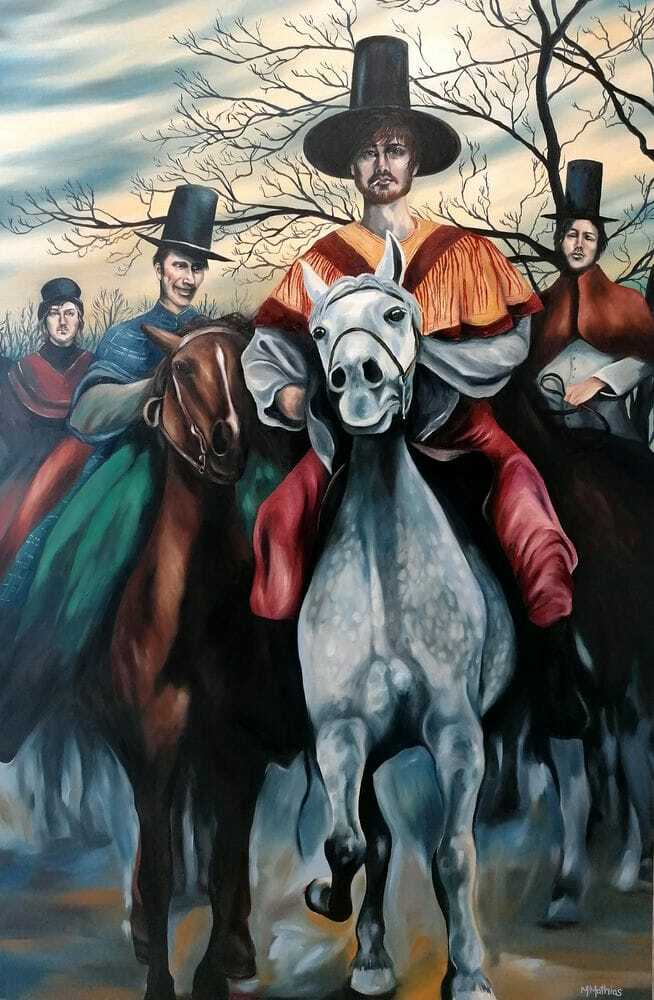
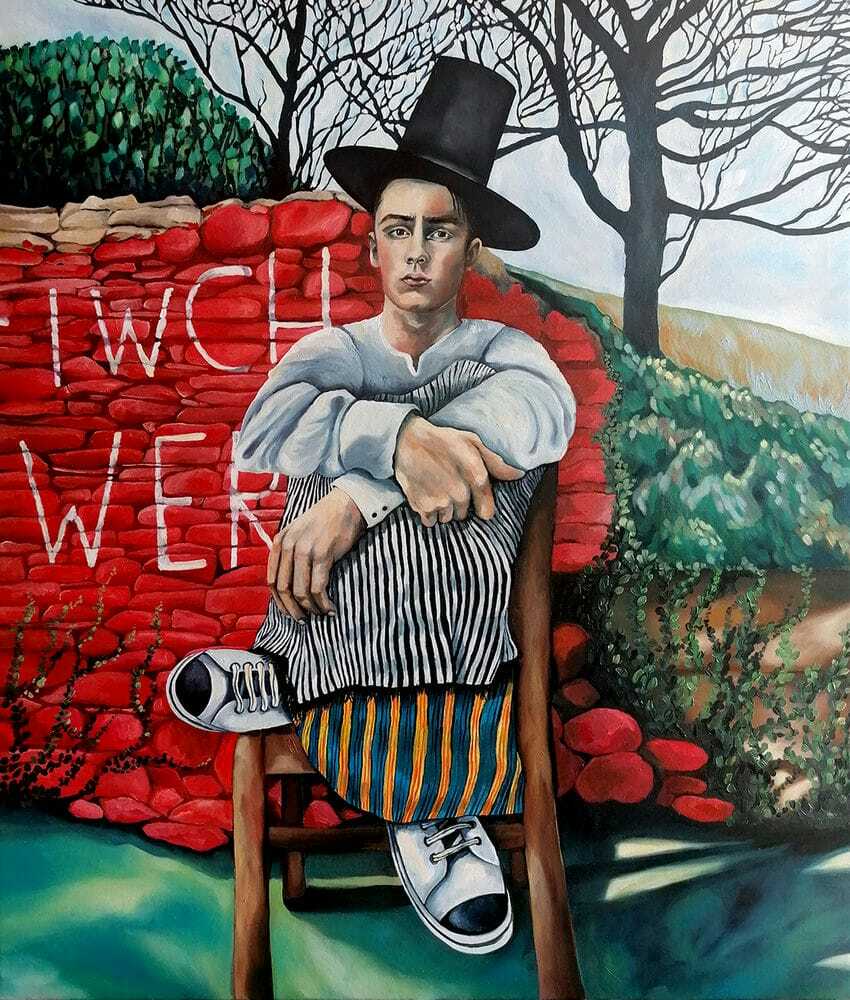
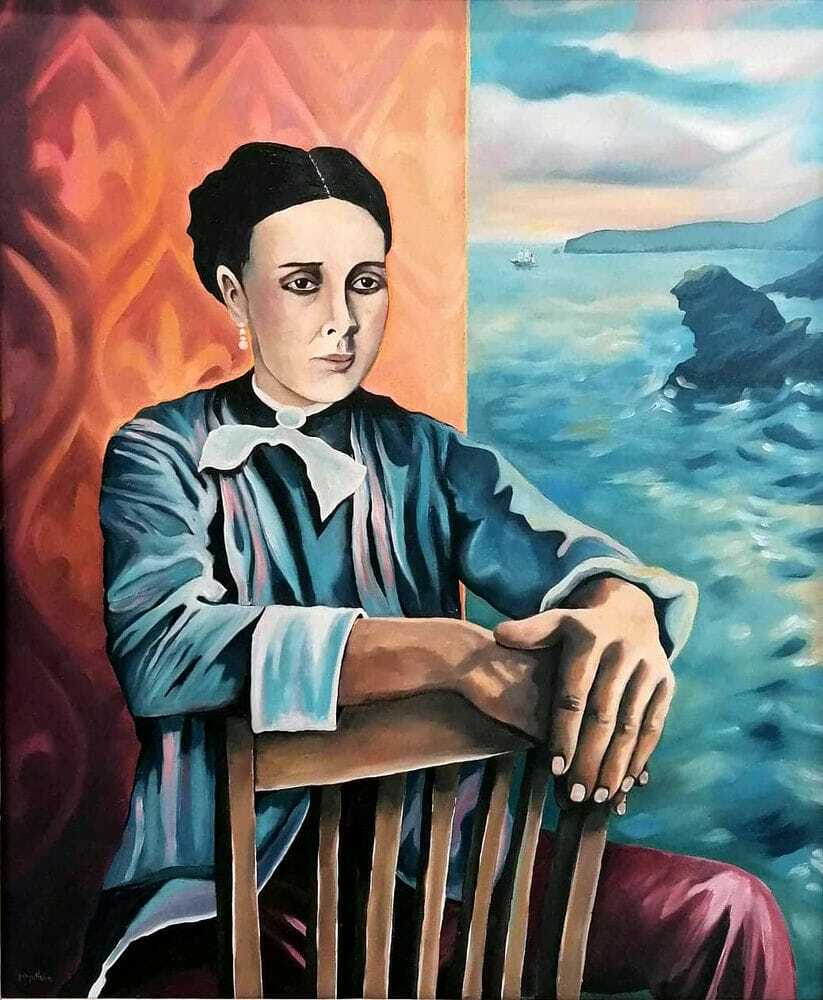
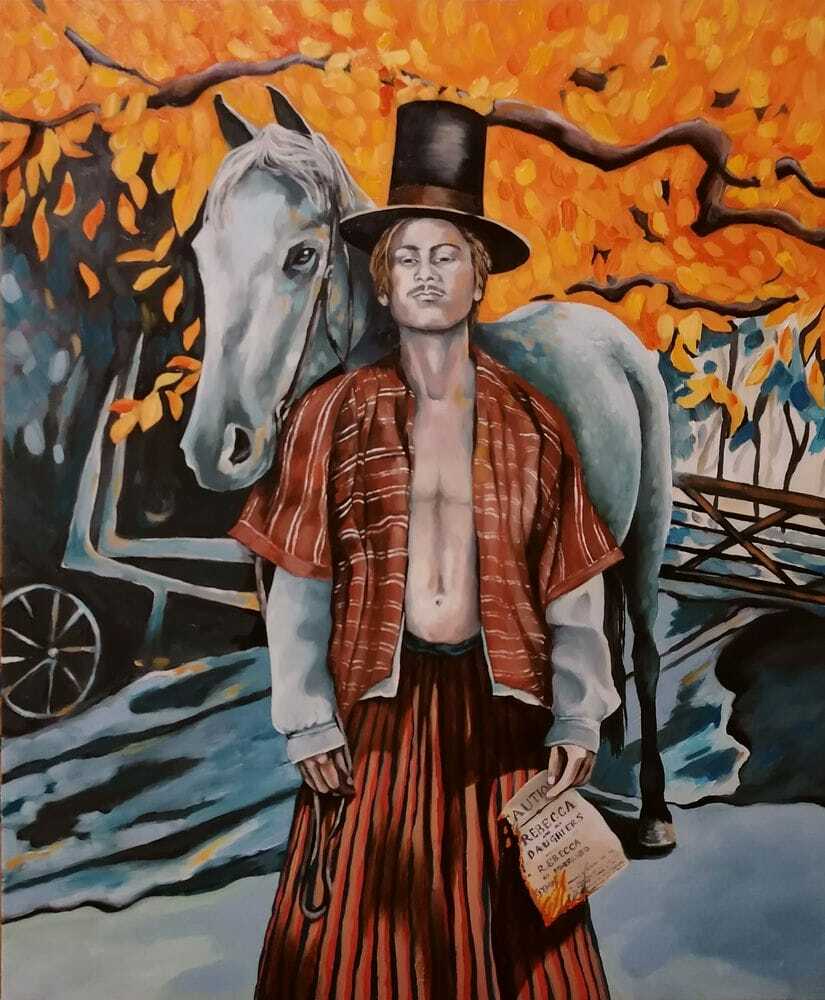
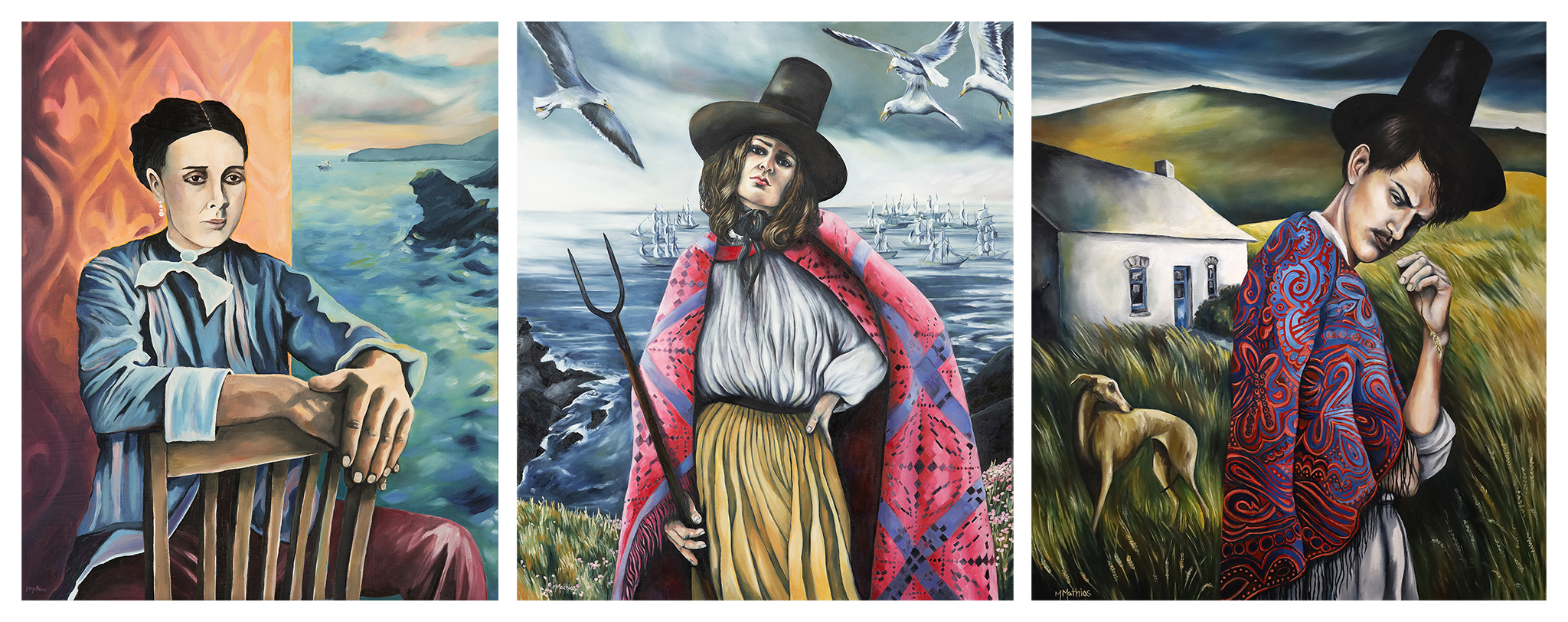
I’ve always been inspired by the landscape, the history and the stories that connect us with the land. My paintings and drawings often reflect on characters from folk stories and history and are re-imagined in a romantic style combined with traditional techniques. Figurative work, colour and composition play a very important role in my paintings. The work often refers to political and cultural struggles throughout Welsh history and are reflected through a contemporary narrative. What inspires me? Well, I would say in very simple terms; people, stories, community, history and land. I enjoy 18th century portrait paintings and early Victorian photographs where characters posed and presented themselves in their best dressed clothes, often to symbolise something important in their lives. I drew some inspiration from these for some of my latest works, a collection of paintings and intaglio prints representing Merched Beca (The Rebecca Riots).

Many artworks - both historical and contemporary - have inspired and informed my painting practice throughout the years but seeing themes relating to Wales and its people has particularly inspired my thinking. Artists such as Ivor Davies, Evan Walters, Brenda Chamberlain, Ernest Zobole, Mary Lloyd Jones, Iwan Bala, Bedwyr Williams to name but a few.

Explain the process that you follow when creating a piece of art.

The first part of the process is research. I always carry a small sketchbook and ideas are often formed through conversations, the people I meet, stories and history. The ideas often formulate through personal experience and connect with my own upbringing or surroundings. The creation of paintings will usually develop through a series of large-scale drawings with charcoal on paper, combining imagery, ideas and people I have drawn and photographed. Once I have found a narrative and a composition to work from, I develop the painting with oil paint on linen or using intaglio printmaking processes.

Which media/materials do you enjoy using the most?

I mainly work with oil paints and intaglio print making making processes. In the past, I have worked with a variety of mediums such as multimedia installations which combine painted imagery with sound, objects and film.

How has your work changed and developed over time?

Over time, I have developed a more figurative approach to my paintings to include character and narrative. I will often refer to objects, symbolism, patterns and fabrics, taking inspiration from the home. In the past, I explored a wide range of materials and processes which is important I think as part of the development of your practice as an artist. I have always been drawn back to oil painting and value the slow drying processes as a method of working. I also really appreciate the fact that printmaking is an unpredictable process.

Complete these activies. Your work will be marked as you go. Remember to take a screenshot of your answers to keep in your personal record.

Activity 1

The first part of the process is research. I always carry a small sketchbook and ideas are often formed through conversations, the people I meet, stories and history. The ideas often formulate through personal experience and connect with my own upbringing or surroundings. The creation of paintings will usually develop through a series of large-scale drawings with charcoal on paper, combining imagery, ideas and people I have drawn and photographed. Once I have found a narrative and a composition to work from, I develop the painting with oil paint on linen or using intaglio printmaking processes.  
research
upbringing
environment
composition
charcoal
combine
narrative
intaglio
A type of printing where the image is scratched into the block (e.g. metal or wood). The scratches hold the ink which is then transferred to create an image.
The place, time or conditions in which a person, animal or plant lives or operates.
Like a story, where a series of events are portrayed.
Searching for information in order to answer a question or learn more about a topic.
A black material created by burning wood without much air. You can use small sticks from it to draw a picture.
How and where a person is brought up, the circumstances in which a person grows up.
The act of uniting things to create a single unit; bringing elements together.
A piece of creative work e.g., a piece of art, creative writing or music.

Activity 2

Look at these images / Edrychwch ar y lluniau hyn.

Cranogwen, Twmcarnabwth, Y noson olaf

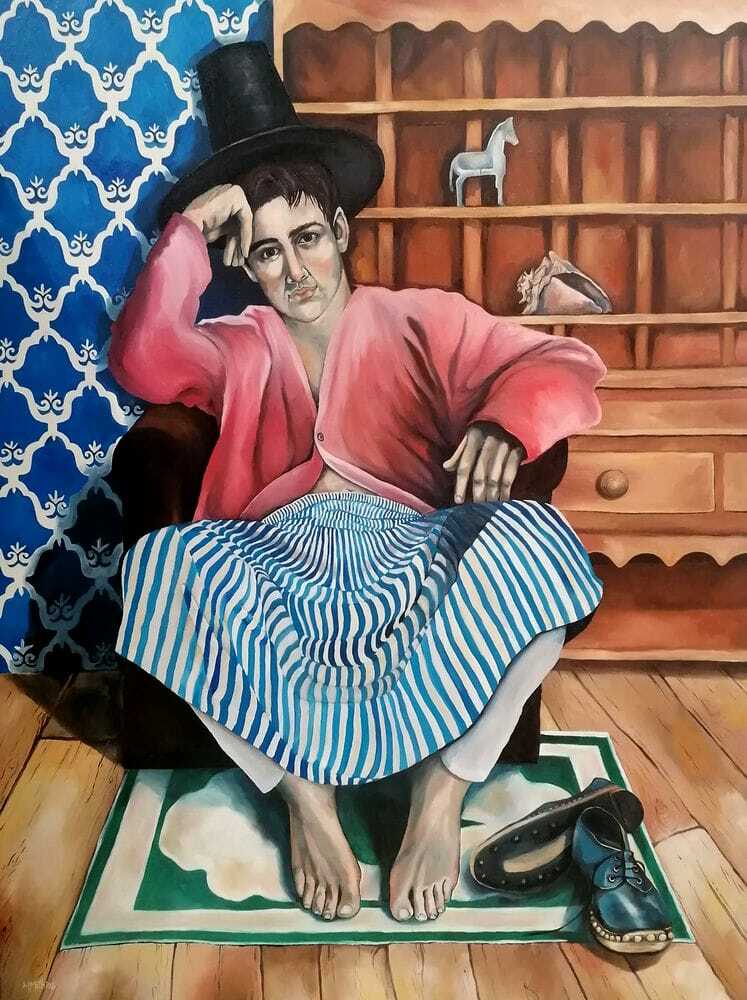
Meinir Mathias uses many traditional clothes in her paintings. / Mae Meinir Mathias yn defnyddio llawer o ddillad traddodiadol yn ei phaentiadau. Match the Welsh and English words which refer to the items of clothing / Parwch y geiriau Cymraeg a Saesneg sy’n cyfeirio at y dillad.

het Gymreig
het ddu
crys gwyn
ffedog
cardigan binc
siôl
trowsus
sgarff
sgert
white shirt
scarf
apron
trousers
black hat
Welsh hat
pink cardigan
skirt
shawl

Remember to take a screenshot of your answers to keep in your personal record.

Vocabulary

cultural memory - remembering events that are linked to things, places or experience, and that belong to a group of people

lecturing - presenting information to a class in a college or university

landscape - the form or character of the land

figurative work - artwork that clearly shows real objects, e.g. the human figure

contemporary narrative - a modern story

composition - the way the different elements of an artwork are arranged

intaglio print making - printing an image on paper from a copperplate

multimedia installations - large scale pieces of art that use different types of media