Cymraeg CY

Welcome to the Celftastig Website


This is a website for practitioners and 11-14 year old learners, with the aim of providing tools and ideas based on activities to inspire the learners to develop the skills of exploring, creating and responding to art. The website is designed around 4 central themes, with an opportunity to look in more detail at the work of around 4 artists under each theme. The activities cover several themes and correspond to various areas of learning and experience in the Curriculum for Wales. These activities are tailored for progression steps 3 and 4 but can be adjusted according to the learner's ability and requirements. You do not need to complete all the activities or follow the order in which they are presented within the themes.

Themes and Artists

Environment

Mary Lloyd Jones, Manon Awst, Tim Pugh a Tim Davies

Identity

Catrin Williams, Lowri Davies a Tomos Sparnon

Culture

Ann Catrin Evans, Mari Thomas, Meinir Mathias a Ruth Jên

Politics

Ifor Davies, Iwan Bala, Neale Howells a Peter Finnemore

There are three sections for each artist.

In the 'Exploring' section, you will find information about the artists in the form of text, pictures, and sound - what inspires them, how exploring through experimentation creates different types of work, along with examples of their work, and the mood and ideas that are conveyed in them.

In the 'Response' section, you will find examples of resources and activities that can be used to develop the learners’ personal response skills to works of art. There is a particular focus on stimulating literacy skills by evaluating and explaining the impact of mood, emotion, and ideas.

In the 'Creating' section, you will find examples of plans and resources that could be used for projects, which experiment with different techniques to emulate the artists' styles. You can either download and print these resources or use them interactively on a device through the Hwb's pdf reader.

Explore and enjoy!
Tim Pugh

Pwy wyt ti?

Tim Pugh ydw i.

Ble cest ti dy fagu?

Ces i fy magu yng Nglannau Dyfrdwy a’r Rhyl.

Ble est ti i’r ysgol?

Es i i Ysgol Uwchradd y Rhyl.

Disgrifia dy addysg.

Es i i Goleg Celf Wrecsam. Wedyn, es i i Goleg Celf Caeredin (Edinburgh) i wneud gradd mewn Cerameg.

Pa fath o artist wyt ti?

Artist Amgycheddol (Environmental) ydw i.

Pa ddefnyddiau rwyt ti’n hoffi eu defnyddio?

Dw i’n hoffi lliw’r dail yn yr hydref (autumn) a phethau naturiol eraill sy’n dod o’r tymhorau (seasons).
Hefyd, dw i'n defnyddio pethau dw i'n ffeindio ar y traeth yn Cumbria.

Beth ydy dy ‘broses’ di?

Dw i’n gweithio yn yr awyr agored (open air). Dw i’n hoffi gweithio’n gyflym i greu llun mewn un diwrnod rhag ofn (in case) bydd natur yn dinistrio (destroy) popeth.

What is your background?

I am an Environmental artist based in Flintshire and West Cumbria. I grew up in various locations in Deeside and Rhyl. After attending Rhyl High School, I went to Wrexham College of Art where I achieved a diploma and higher national diploma in ceramics. I was then fortunate enough to attend Edinburgh College of Art where I gained a degree in ceramics. After living for a while in Scotland, I returned to Mancot to live with my grandmother and continued to develop my career as an artist, meeting and establishing new contacts with arts officers, galleries and schools.

I started to exhibit my work in galleries across Wales and very gradually across the UK and overseas, as well as undertaking school and community workshops. I have participated in many residencies, exchange programmes, and other long-term projects across the UK and internationally, as well as winning awards and travel grants. Overseas projects have included pavement art in Dubai, community workshops in Poland and Europe, snow art residencies in Montana, USA, Tasmania and Switzerland and school workshops in Oviedo in Spain.

I have been an advisor and Creative Agent and Practitioner for the Arts Council of Wales and more recently in the last two years, attended an Environmental Art residency / land art festival in Llano, Texas.

What or who has influenced/inspired you the most?

I have been influenced by many artists such as Richard Long, Andy Goldsworthy, Henry Moore, Robert Smithson and many other artists working in a wide variety of different media and materials. I was inspired by teachers and college lecturers along the way and encouraged to research many artists and to try out and experiment with different processes. At Edinburgh, I was encouraged to work with clay outdoors which gradually led me to work with natural materials and to create and cite work in natural site-specific locations.

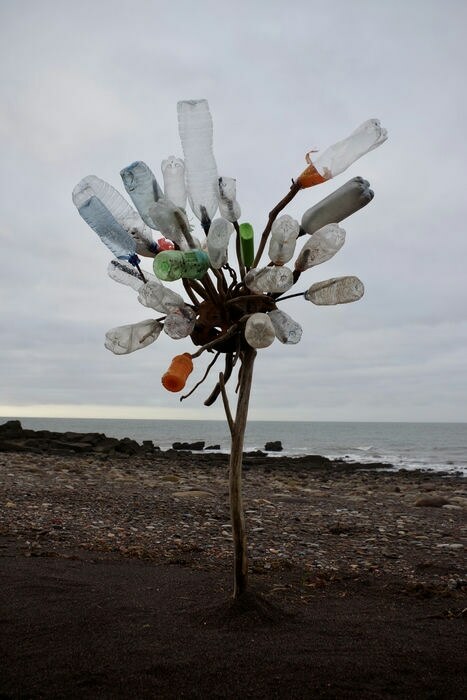
I am generally inspired a great deal by nature and have always enjoyed collecting fossils. I am interested in astronomy, growing cacti and other outdoor pursuits which have filtered through into my practice. I often draw natural objects and have more recently been incorporating beach finds into my work, such as Victorian pottery and plastic materials harvested from the tideline.

I am inspired also by the countryside in general and like to collect shells as well as fell walking in West Cumbria. I don't drive but have easy access to the Western Fells from my other place of work in Cumbria and cycle to the mountains to walk, take photographs and research new places to create work.

Explain the process that you follow when creating a piece of art.

When creating outdoor work or commissioned to make installations in a gallery, I often sketch out initial ideas as design sheets which document my thought processes using a wide range of mixed media. These are often exhibited next to my installations which also help to communicate my ideas to onlookers and students.

I am increasingly working on beach locations and always check the weather forecast beforehand! I often don’t have a preconceived idea before I go to the beach or woodland and respond to the materials the tide has deposited on the beach or respond to the seasons which determines what woodland debris is available.

I often incorporate maps, drawing and text into my work, maybe as a result of prior research done online or when visiting libraries. I always carry lots when working outdoors and take a medium format and 35mm film camera, as well as two digital cameras to document my work and a tripod. I always pack various art materials and very often take them with me on a bike, or bus or train, or maybe use all modes of transport to various sites.

I like to work quickly outdoors, creating an art intervention or rock drawing within a day as very often nature will intervene overnight, such as the tide coming in or heavy snowfall or rain wiping out all traces of artwork.

When creating installations for galleries, I take longer to create responses, maybe up to a week, where I may site and construct several artworks or hang large photographs and drawings.

Which media/materials do you enjoy using the most?

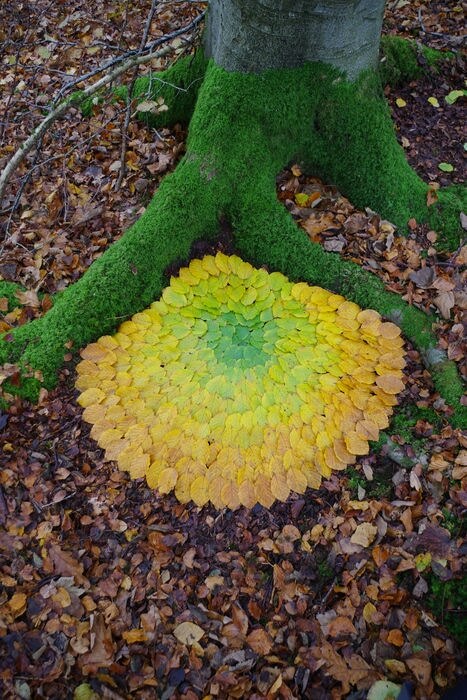
There are many different types of materials that I have enjoyed handling over the years, each with their own distinctive properties and characteristics. Freshly fallen autumnal beech leaves are very satisfying when used to create colour coordinated arrangements as are other seasonal deposits from the flora and fauna.

Snow is also an increasingly rare medium for creating 2 and 3 dimensional responses. I remember undertaking a winter residency for the University of Montana in Bozeman and witnessing snowfall in autumn...I combined environmental artworks with autumn and winter materials which highlighted their individual colours and textures. When I returned to Wales in December, further prolonged bouts of snowfall extended my winter season into April, and it was surprising to see the differences in the properties between American and Welsh snow. Much to my surprise, that snowy phase lasted from October to April, giving me prolonged time to experiment with the wintry precipitation.

More recently, I have been working with manmade materials such as Victorian glass and ceramic, washed up on the tideline in Whitehaven in Cumbria. The beach was used as a dumping ground or rubbish heap, and domestic refuse was dumped off the harbour straight into the sea. I have retrieved beautiful relics, reflecting a bygone generation and have created site specific maps and other temporary artworks incorporating these products.

How has your work changed and developed over time?

For many years I had been creating 'decorative' artworks and felt I was in a creative rut, creating spirals and other 'pretty' patterns that increasingly began to disengage me. What broke the spell was undertaking the Montana residency where I met inspirational tutors who gently encouraged me to consider other issues that could be incorporated into my work. I was always interested in current affairs and environmental issues, and these began to surface in my work. Since then, I have built on my portfolio by making art that is influenced by green issues and concerns, yet still retaining a decorative level or element.

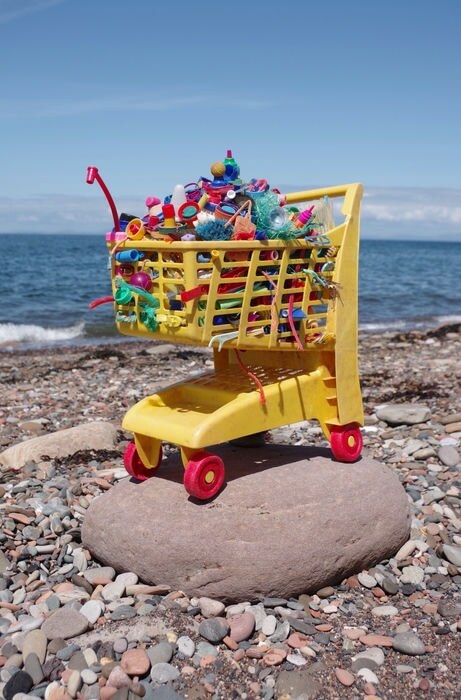
Discovering South Beach in Cumbria has provided further drive and scope to develop and experiment with the vast array of debris washed up on the tideline. The beach has, in effect, informed and guided my practice where I have created many examples that directly relate to environmental concerns by using plastics and other detrimental products.

This beach is closed to the public due to unstable slag heaps from an old colliery making it a dangerous location, but I have found a hidden access point which the local fishermen use. The same slag heaps are rounded into toxic pebbles that can produce beautiful effects when scratched onto smooth surfaces.

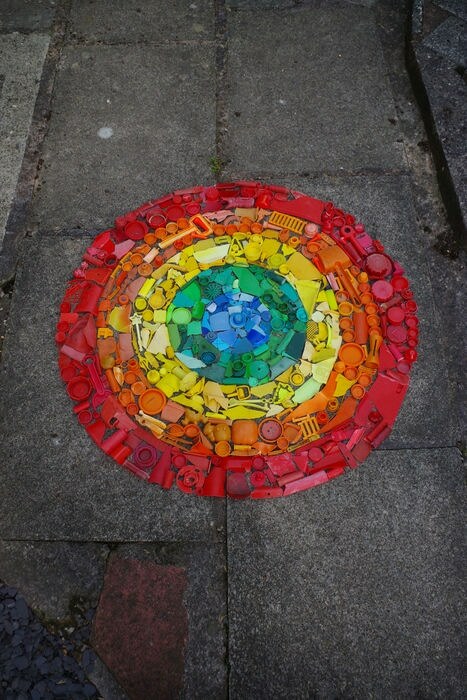
Plastic cones and pipes randomly washed up provide the opportunity to make fantastic colourful creations, particularly after storms. An element of play and humour has crept into my work, creating drawings from lost plastic toys drawn onto plastic. My homes in Cumbria and Wales are gradually filling up with materials I have retrieved, and they now form part of educational resources I take to schools for pupils to explore whilst reflecting on environmental issues.

It can, of course, be dangerous but the beach remains an enduring and fascinating place to create and is currently my favourite location.

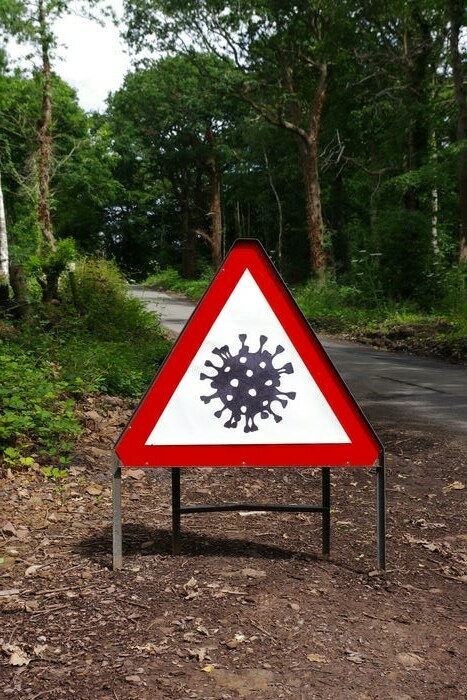
In lockdown, I created a series of artworks based on future envisaged road signs that warns of the covid virus. This latest development underscores my transition and evolution prevalent in my work and I continue to work in the same vein.

Complete these activies. Your work will be marked as you go. Remember to take a screenshot of your answers to keep in your personal record.

Activity 1

stone
shell
leaf
twig
woodlouse
berry
brick
wing
bone
woodlice
bricks
leaves
bones
seeds
twigs
shells
stones
berries

Activity 2

Tim Pugh uses materials. It depends on what is at the time. When he is at the , he can use various and . Sometimes he finds glass and . In , there are materials such as and branches.

Remember to take a screenshot of your answers to keep in your personal record.

Vocabulary

residency - a temporary period of time for an artist to work on a project or develop new ideas in a different location (sometimes abroad), which gives him an opportunity to work on a project or develop new ideas in a different location

site-specific - a work of art that has been designed for a specific location and is connected to that location

debris - pieces that are broken or torn after something larger has been destructed

art intervention - artwork that has been designed specifically to interact with a situation that exists already e.g., another artwork, the audience or an institution

precipitation - any kind of weather where something is falling from the sky e.g., rain, snow, sleet or hail

relic(s) - object(s) from the past, often valued for their importance in history

detrimental products - products than cause harm or damage

slag heap(s) - a hill made from waste material, such as rock and mud, left over from mining.